Category Archives: AOA News Letter
TIMOR-LESTE HOSTS 21ST ANNUAL CONFERENCE OF SOUTHEAST ASIA NATIONAL HUMAN RIGHTS INSTITUTIONS FORUM (SEANF).
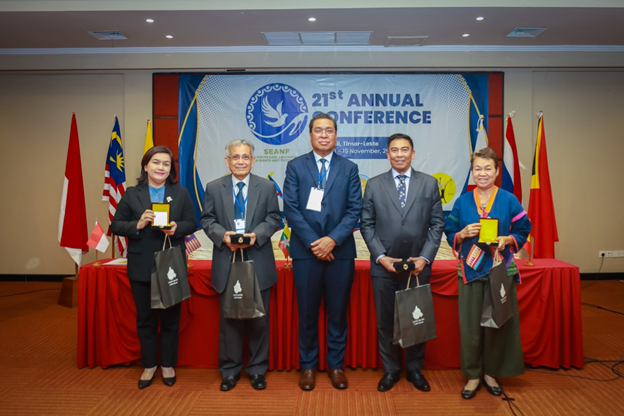
Dili, Timor-Leste – November 19, 2024 – The Southeast Asia National Human Rights Institutions Forum (SEANF) concluded its 21st Annual Conference today in Dili, Timor-Leste, with a renewed commitment to advancing human rights across the region. The conference, held on November 18-19, 2024, brought together National Human Rights Institutions (NHRIs) from Southeast Asia, as well as international partners and key stakeholders, to discuss critical human rights issues facing the region.
This year, the Ombudsman for Human Right and Justice (PDHJ) of Timor-Leste is serving as the Chairperson of SEANF, and under its leadership, the Forum organized two technical working group meetings and the annual conference. These efforts highlight PDHJ Timor-Leste’s growing role in regional human rights advocacy. The chairmanship will be handed over to Komnas HAM, Indonesia, in 2025, with plans for continued collaboration on issues such as torture prevention, statelessness, migrant rights, and digital rights.
At the conference, participants discussed key priorities outlined in SEANF’s Strategic Plan (2022–2026), including ensuring human rights in the context of the COVID-19 pandemic, advancing business and human rights, and preventing torture. Notable outcomes from the conference include updates on SEANF’s initiatives to address cross-border human rights challenges, particularly statelessness in Southeast Asia, and the Forum’s continued commitment to addressing the rights of marginalized groups, such as older persons and stateless communities.
Key Outcomes and Future Commitments
The 21st Annual Conference highlighted important progress on SEANF’s four key priorities:
- Human Rights and COVID-19: SEANF reaffirmed its commitment to ensuring that human rights remain central to national responses to the COVID-19 crisis, particularly for marginalized communities.
- Human Rights in Business: SEANF continued its work on advancing human rights in business, with a focus on ensuring accountability and corporate responsibility in Southeast Asia.
- Torture Prevention: SEANF members renewed their commitment to preventing torture and other cruel, inhuman, or degrading treatment or punishment, with ongoing efforts to strengthen monitoring mechanisms.
- Strengthening SEANF’s Institutional Capacity: The Forum continued discussions on the future structure of SEANF’s Secretariat and the duration of the chairpersonship term, with an agreement to follow the chairmanship rotation model and further explore a permanent Secretariat.
Additionally, SEANF members affirmed their support for regional initiatives such as collaboration with ASEAN on migrant worker rights and the rights of victims of human trafficking. The Forum also recognized the growing importance of digital rights and cyber security, and committed to engaging in discussions at the upcoming RightsCon event in 2025.
Addressing Statelessness and Marginalized Communities
A key issue discussed was the ongoing challenge of statelessness in Southeast Asia, particularly in the context of communities living along border areas. SEANF members expressed their support for the Memorandum of Understanding (MOU) between the Commission on Human Rights of the Philippines (CHRP), SUHAKAM of Malaysia, and Komnas HAM of Indonesia, which seeks to address the human rights concerns of stateless persons, especially the Filipino and Indonesian communities in Sabah, Malaysia. The MOU, renewed in 2023, will remain in effect until 2028, and SEANF members pledged to continue their advocacy for the protection of stateless persons and refugees in the region.
Looking Ahead
As PDHJ Timor-Leste’s chairmanship of SEANF concludes in 2024, the Forum looks forward to the continued leadership of Komnas HAM, Indonesia, which will assume the chair in 2025. SEANF members reaffirmed their commitment to deepening collaboration, strengthening partnerships with international bodies such as the UNHRC and APF, and advancing human rights for all people in Southeast Asia.
Call for Action
SEANF calls on all its members to continue engaging in dialogue, sharing best practices, and participating in joint initiatives to promote and protect human rights across the region. The Forum encourages governments, civil society, and other stakeholders to collaborate in ensuring that human rights remain a central focus of national and regional policies.
In closing, SEANF members reaffirm their dedication to the principles enshrined in the Universal Declaration of Human Rights and the Paris Principles, pledging to continue their collective efforts to ensure the realization of human rights for all people in Southeast Asia.
Adopted on: November 19, 2024
For and on behalf of the Southeast Asia National Human Rights Institutions Forum (SEANF)
Signed by:
Dr. Atnike Nova Sigiro, Chairperson, Indonesia National Commission on Human Rights (Komnas HAM)
Dato Seri Mohd Hishamudin Yunus, Chairperson, Suruhanjaya Hak Asasi Manusia Malaysia
(SUHAKAM)
Atty. Richard P. Palpal-latoc, Chairperson, Commission on Human Rights of Philippines (CHRP)
Mrs. Preeda Kongpaen, Commissioner, National Human Rights Commission of Thailand (NHRCT)
Mr. Paw Lwin Sein, Chairperson, Myanmar National Human Rights Commission (MNHRC)
Mr. Virgílio da Silva Guterres “Lamukan”, Provedor de Direitos Humanos e Justiça (PDHJ)
THE INTERNATIONAL BAKU FORUM OF OMBUDSMEN ON “CLIMATE CHANGE AND HUMAN RIGHTS: THE ROLE OF OMBUDSMEN AND NHRIS” HELD.
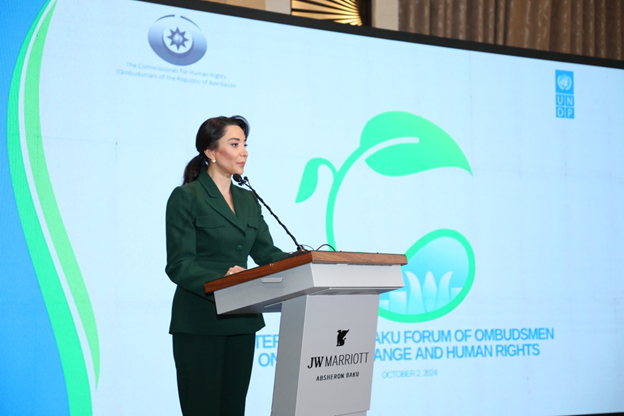

The International Baku Forum of Ombudsmen “Climate Change and Human Rights: The Role of Ombudsmen and National Human Rights Institutions (NHRIs)” was held at the initiative of the Azerbaijan Ombudsman and with the support of the State.
The event, organized to discuss the challenges posed by global climate change and their solutions from a human rights perspective, as well as to share positive experiences in this field, brought together in total over 200 participants, including 60 participants from about 30 countries. The ombudsmen and representatives of NHRIs, information commissioners, high-ranking state officials, leaders and representatives of civil society and several international organizations, and climate change and human rights experts took part in the event.
Farid Ahmadov, the Minister of Justice of Azerbaijan, conveyed President Ilham Aliyev’s message to the Forum participants.
The message highlights the severe consequences of Armenia’s three-decade military aggression so far, posing great danger to human lives and the environment. It was noted that Armenia committed acts of ecocide, urbicide, and culturicide in the territories held under occupation for a long time, polluting and poisoning our lands and rivers, destroying our forests, and demolishing our cities and villages. Furthermore, numerous landmines, which cost human lives and cause significant environmental damage, were planted in these areas. The message also emphasized the destruction of cultural heritage of global significance and the devastation of religious and cultural sites belonging to Azerbaijanis.
The message also states that the theme of the International Baku Forum holds special relevance for all of humanity, as climate change is one of the global problems threatening the sustainable development and security of all countries. It was noted that climate change poses significant challenges in terms of the protection and fulfillment of fundamental human rights.
In her opening speech, the Human Rights Commissioner of Azerbaijan, Sabina Aliyeva, expressed her deep gratitude to President Ilham Aliyev for his message to the participants of the Forum.
The Ombudsman said that global climate change creates a number of problems for the environment, the sustainable development of countries, and the protection of human rights. She emphasized that the impacts of climate change are not limited to the territory of just one country or region and stressed the importance of increasing attention to ensuring the right to live in a healthy environment.
The Ombudsman highlighted that our lands were occupied by Armenia for nearly thirty years and noted the severe environmental damage and harm to biodiversity in those areas during this period, calling attention to the crime of ecocide. She emphasized that various rare species of plants and animals of Azerbaijan were destroyed, and rivers flowing through our territories were heavily polluted with harmful substances, posing a serious threat to the life and health of the population.
Speaking about Armenia’s landmine terrorism in our territories during the occupation, the Ombudsman stated that since the Second Karabakh War, nearly 380 people have become victims of landmines. It was highlighted that the buried landmines hinder the safe return of former IDPs to their lands and obstruct the reconstruction and building efforts in the region. In addition, she noted that landmine explosions have disrupted the ecological balance in the region.
- Aliyeva noted that Azerbaijan places special emphasis on combating the negative effects of climate change and the potential risks arising from it, in line with the commitments derived from the UN SDGs, emphasizing ongoing comprehensive initiatives to protect the environment and mitigate the impacts of climate change.
Mukhtar Babayev, the Minister of Ecology and Natural Resources and the designated President of COP29, stated, in his speech, that climate change and its negative impacts on the environment are among the major problems that concern the world. It was pointed out that climate change exacerbates inequality and vulnerable groups are the most affected category.
Alessandra Roccasalvo, the UNDP Resident Representative in Azerbaijan, noted that the Forum serves as an important platform for both seeking solutions to existing problems and for training future leaders. She provided information about the “Climate Change and Human Rights” research competition organized jointly by UNDP and the Ombudsman Office, emphasizing the significance of the central role of youth in climate action.
Noura Zaid Alrshoud, the OIC-IPHRC Secretariat Executive Director, said that deforestation, the illegal exploitation of natural resources, the pollution of rivers, and the indiscriminate placement of landmines in civilian and military objects cause significant harm to the environment. She emphasized that such actions severely violate the principles of international human rights and humanitarian law.
The Executive Director also said that climate change and its consequences negatively impact the effective realization of human rights, emphasizing that NHRIs play a crucial role in addressing climate change.
Subsequently, the conference participants watched a video message from Volker Türk, the UN High Commissioner for Human Rights.
The event also featured the award ceremony for the winners of the Ombudsman / UNDP Joint Student Research Paper Competition “Climate Change and Human Rights”.
The forum continued its work in panel sessions on: “Support strategies for NHRIs and ombudsman offices in climate change initiatives,” “Public access to information on climate change and its effects,” “Cooperation Perspectives and collaborative development,” “Climate change and its intersection with Landmines and Explosive remnants of war (ERW),” and ” Fostering business accountability in the context of climate change.”
Presentations on various topics were heard during the sessions, and extensive discussions took place.
Also, calls for action and future cooperation prospects were thoroughly discussed.
In conclusion, the Declaration of the International Baku Forum of Ombudsmen was announced and unanimously adopted. The declaration will contribute to strengthening the role of ombudsmen and NHRIs in addressing ecological issues, as well as to raising awareness in the relevant field.
OMBUDSMEN OF UZBEKISTAN AND AUSTRIA: COOPERATION IN HUMAN RIGHTS PROTECTION.
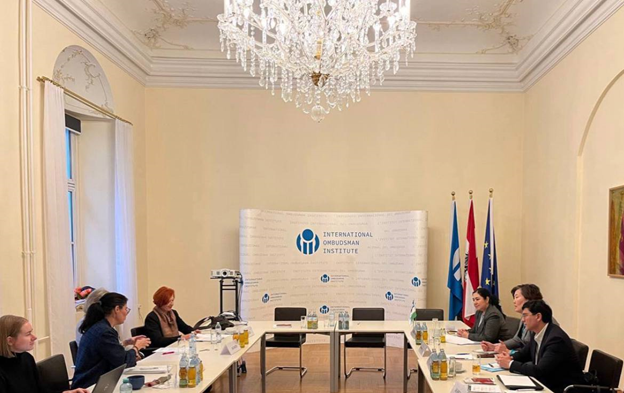
The Authorized Person of the Oliy Majlis for Human Rights (Ombudsman) of Uzbekistan is currently on a visit to Austria at the invitation of the Austrian Ombudsman Board.
On November 19, 2024, the Ombudsman of Uzbekistan, Feruza Eshmatova, met with the Chairperson of the Austrian Ombudsman Board, Gaby Schwarz. The meeting, held at the Austrian Ombudsman Board’s headquarters, provided an opportunity for the two sides to exchange experiences and gain deeper insight into each other’s work.
Established in 2012, the Austrian Ombudsman Board oversees the activities of state institutions, monitors conditions in prisons and nursing homes, and ensures the implementation of programs and the provision of services for people with disabilities. The Board also examines complaints related to human rights violations.
During the meeting, the parties discussed their respective experiences and new approaches in human rights protection. They also explored several initiatives aimed at expanding cooperation between the ombudsmen of Uzbekistan and Austria.
At the conclusion of the meeting, both sides agreed on measures to strengthen collaboration between the Austrian Ombudsman Board and the Authorized Person of the Oliy Majlis for Human Rights (Ombudsman) of Uzbekistan.
On the same day, the Uzbek delegation met with members of the Advisory Council under the Austrian Ombudsman Board. Since 2022, the Chairperson of the Austrian Ombudsman Board has also held the position of Secretary General of the International Ombudsman Institute (IOI).
The International Ombudsman Institute (IOI), founded in 1978, is the only global organization representing over 200 ombudsmen from more than 100 countries. The Authorized Person of the Oliy Majlis for Human Rights (Ombudsman) is a full-fledged member of this organization.
EXPANSION OF THE ‘EASY ADMINISTRATIVE APPEALS’ SERVICE “FASTER AND MORE CONVENIENT.”

– Review of ‘EASY Administrative Appeals’Service Usage in the First Half of 2024: User Satisfaction Reaches 87.3 Points, Service Coverage Expanded to 68 Institutions
– Plans to Further Expand Coverage to Lower Barriers for Citizens Seeking Rights Protection
(10, October. 2024, ACRC)
The institutions providing the administrative appeal form auto-completion service (EASY Administrative Appeals) are expected to continue expanding.
The Anti-Corruption and Civil Rights Commission (ACRC), under Chairperson Ryu Chul Whan, is spearheading the expansion of the EASY Administrative Appeals service, an innovative solution aimed at simplifying the process of filing administrative appeals. The service is designed to empower citizens, particularly those without legal expertise, to challenge unfair administrative actions such as license suspensions, fines, or exam failures more efficiently and effectively.
The Anti-Corruption and Civil Rights Commission (ACRC), led by Chairperson Ryu Chul Whan, is driving the expansion of the EASY Administrative Appeals service. This cutting-edge initiative simplifies the process of filing administrative appeals, empowering citizens especially those without legal expertise to efficiently address unfair administrative actions, such as license suspensions, business penalties, fines, or examination failures.
Filing an administrative appeal can be daunting for citizens unfamiliar with legal procedures. To address this challenge, the ACRC launched the EASY Administrative Appeals service in February 2023. By entering a few essential details, such as the date of the administrative action, users can generate appeal forms automatically using the system’s auto-completion technology, which references similar cases.
Citizens can access this service by visiting the ‘Online Administrative Appeals’ platform (www.simpan.go.kr) and selecting the ‘EASY Administrative Appeals’ option.
Between January 1 and July 23, 2024, 13,068 users accessed the system, generating 104,095
auto-completed forms and successfully filing 533 appeals.
User satisfaction ratings have risen notably, from 82.6 points at the service’s launch to 87.3 points by the end of 2023. Positive feedback reflects the system’s ability to reduce procedural barriers for users.
Originally limited to appeals addressed to the Central Administrative Appeals Commission, the service has expanded to include 68 institutions, including local governments and education offices, significantly broadening its reach.
At the 47th National Policy Agenda Meeting on October 10, chaired by the Prime Minister, the ACRC reviewed the performance of the EASY Administrative Appeals service and outlined plans for further improvements. It was decided that functional challenges in specific institutions should be resolved by the end of 2024 to minimize user inconvenience. In addition, priority will be given to launching the service in individual administrative appeals commissions with high citizen usage rates.
In addition, efforts will focus on integrating the administrative appeal systems currently operated by various institutions. Starting in 2026, the EASY Administrative Appeals service will be further enhanced with AI technologies, including ChatGPT, to better support citizens without legal expertise.
Park Jong-min, ACRC Secretary-General and Chairperson of the Central Administrative Appeals Commission, stated, “In line with the government’s goal of implementing a digital platform, we will continue to expand the EASY Administrative Appeals service to make it more accessible for citizens to file administrative appeals.”
OMBUDSMAN ANNOUNCES RESULTS OF DIRECT INVESTIGATION OPERATION INTO LCSD’S HANDLING OF OBSTRUCTIONS TO PASSAGEWAYS BY BICYCLES OWNED BY OPERATORS OF BICYCLE RENTAL SERVICES.

The Ombudsman, Mr Jack Chan, today (21 November) announced the completion of a direct investigation operation into the handling of obstructions to passageways by bicycles owned by operators of bicycle rental services of the Leisure and Cultural Services Department (“LCSD”), and made eight recommendations to the Department.
A total of 14 recreational venues managed by the LCSD have bicycle rental services provided by operators engaged by the Department for members of the public to rent bicycles for leisure or short-distance travel.
Contract terms of the relevant business permit (“permit”) issued by the LCSD explicitly forbid placing bicycles and articles relating to bicycle rental services outside the permit area. However, Ombudsman investigations have revealed that it is common for operators to place their bicycles outside the permit area in violation of contract terms. The Ombudsman also found that the existing enforcement mechanism of the LCSD against operators is not consistent.
Mr Chan said, “The LCSD, as the venue manager and permits issuer, is duty-bound to monitor the operators of bicycle rental services. Operators placing their bicycles outside the permit area in violation of regulations not only causes an obstruction to passageways and affects members of the public to access and use recreational facilities, but may also pose safety hazards. Our multiple site inspections found that it seems to be a common practice for operators to leave bicycles lying around in contravention of the regulations, and this has invited doubts as to whether the LCSD had reminded the operators of the irregularities or has taken enforcement action against them in the past.”
LCSD staff issue reminders or warning letters to operators based on the gravity of the irregularities found. If no improvement is evident after the third warning letter, the LCSD can consider suspending the operator’s business or terminating the contract. However, the current guidelines do not clearly specify how many verbal and written reminders would warrant a warning letter, or whether written reminders and warning letters have a validity period. The Ombudsman is of the view that in order to carry out enforcement more efficiently and fairly, the LCSD should enhance the current enforcement regime and the relevant guidelines, for example, by specifying clearly that the Department will issue a warning letter if a cumulative number of verbal or written reminders are given within a certain period of time, and that the criteria for the issuance of a warning letter should be made public.
On the other hand, it has been noted that operators display bicycles of various models outside bicycle kiosks for customers to choose and try. This is not unreasonable, and may even have a practical need. The Ombudsman considers that while the LCSD has a duty to monitor compliance with permit contract terms, it should, as the department responsible for promoting recreational activities, also conduct a review on whether the current regulatory regime is too restrictive for the operators in the business. If necessary, the Department should examine whether operators can be allowed to use the space outside the permit area as long as the relevant regulations are complied with. In the long run, the LCSD should consider including part of the venue as the permit area when drafting new contracts for bicycle rental services in the future for better management.
The Ombudsman has made a total of eight improvement recommendations to the LCSD, including:
- keep monitoring the operator concerned closely. Should it continue to occupy the space outside the permit area in violation of contract terms, decisive enforcement action must be taken;
- strengthen monitoring of bicycle rental services operators, and take decisive enforcement action against irregularities pursuant to permit contract terms;
- step up staff training on the enforcement of permit contract terms and relevant procedures to ensure that enforcement actions are taken rigorously, accurately and effectively;
- examine how to enhance the current enforcement regime and relevant guidelines to carry out enforcement work in a more efficient and fairer manner in accordance with consistent standards;
- conduct a comprehensive review on the operation of bicycle rental services at venues under its purview, and to examine the feasibility of allowing operators to use areas outside the permit area for placing bicycles, subject to compliance with the relevant requirements;
- consider revising the terms of future permit contracts to suitably include a certain area outside the bicycle kiosk as part of the permit area for better management;
- collect information on the performance of operators (especially irregularities and their approach to complying with reminders and warning letters, etc) and include such information into the LCSD database as the basis of reference in approving new permits in the future; and
- step up publicity to encourage members of the public to monitor operators’ performance and report irregularities to the LCSD at once.
The Office is pleased to note that the LCSD has accepted all the improvement recommendations made.
INTERNATIONAL COOPERATION PLAYS A BIG ROLE IN THE WORK OF THE OMBUDSMAN.
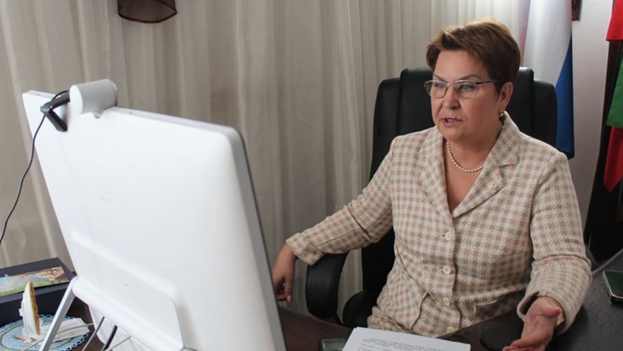
International cooperation plays a big role in the work of the Ombudsman. In their activities, ombudsmen around the world cooperate and are outside the framework of politics, our main task is to restore violated rights of citizens and their protection.
Today I spoke at a meeting of the Expert Council under the representative of the Ombudsman of the Republic of Kazakhstan in Astana. In her report she noted that our institute this year celebrated its 24th anniversary, and during this time much has been done to protect the rights of citizens, improve legislation and legal education. The Expert Council actively helps us to solve the issues of human rights activities, facilitating effective interaction with state bodies and civil society. This institution is only in its infancy among our colleagues.
I hope that the experience of the Expert Council under the Ombudsman in Tatarstan will help our colleagues to build effective human rights tactics, and their Council will become a reliable support for the institution of the Ombudsman.
“PROTECTOR OF HANSEN’S DISEASE PATIENTS,” ACRC CHAIRPERSON RYU CHUL WHAN, VISITS SEONGJAWON IN ANDONG TO HEAR CONCERNS.

– Celebrating the 71st anniversary of Seongjawon in Andong with an on-site visit and meeting
– Review of implementation status for recommendations on settlement area improvements and gathering of on-site feedback
(17, October. 2024, ACRC)
On October 17, Anti-Corruption and Civil Rights Commission (ACRC) Chairperson Ryu Chul Whan visited Seongjawon, a Hansen’s disease care facility in Andong, to meet with officials from Seongjawon and Andong City. This visit included a comprehensive review of the progress made on ACRC’s recommendations from December 2021, which focused on strengthening rights protection and enhancing the environmental and welfare conditions of Hansen’s disease patient settlements. Updates were also shared on the mediation efforts underway since October 2023, and Chairperson Ryu engaged in a listening session to address residents’ concerns directly.
* Seongjawon, established in 1953, provides medical, social, economic, and psychological rehabilitation to Hansen’s disease patients and their families, who have long been marginalized in society.
** Gaemyeong Village in Andong, created in 1959, has faced significant challenges due to deteriorating infrastructure, with disused livestock sheds and 92 abandoned buildings, impacting both the landscape and residents’ health.
Following a nationwide study of 82 Hansen’s disease settlement areas, the ACRC, in December 2021, recommended action to 66 local governments—including Gyeongsangbuk-do and Andong City—and nine central agencies, such as the Ministry of Health and Welfare and the Ministry of Agriculture, Food and Rural Affairs. These recommendations aimed to protect the rights of Hansen’s disease patients and improve settlement conditions.
In November of last year, the ACRC facilitated an agreement with five care facilities, Cheongju City, the Korea Disease Control and Prevention Agency, and other relevant bodies to ease admission standards and establish tailored criteria for Hansen’s disease care facilities. Since then, the ACRC has conducted multiple on-site inspections to monitor the implementation of these improvements.
- Notable visits for implementation reviews have included the Ever Green Welfare Center in Cheongju (February 7), St. Lazarus Village in Uiwang City and the Korea Hansen Welfare Association (March 22), National Sorokdo Hospital, Aeyang Pyeongan Nursing Home in Yeosu, and Doseong Village (May 17), and Seongsimwon in Sancheong (June 26).
Through this recent visit, the ACRC reaffirms its commitment to the implementation of previous recommendations while offering guidance to address any emerging challenges. Issues identified on-site, or those requiring further action, will be tackled through thorough investigations and coordinated efforts with relevant agencies.
- Examples of Resolved Issues:
– Mediation to halt the demolition of 197 buildings in Bupyeong Village, Incheon (November 29, 2022)
– Regulatory relaxation to admit non-beneficiaries into Hansen care facilities (November 7, 2023)
– Mediation to address livestock odor disputes in Yeongmin Village, Yeonggwang County, Jeollanam-do (July 3, 2024)
Chairperson Ryu Chul Whan noted, “This visit, coinciding with Seongjawon’s 71st anniversary, is a meaningful opportunity to recognize the struggles of Hansen’s disease patients who have faced societal prejudice and to work alongside stakeholders in addressing the unique challenges of Hansen facilities and settlements.”
He added, “The ACRC remains dedicated to protecting the rights of Hansen’s disease patients and will prioritize visiting vulnerable communities to listen to their needs and offer essential support.”
OMBUDSMAN PROBES GOVERNMENT’S MONITORING AND REGULATION OF SLOPE SAFETY.

The Ombudsman, Mr Jack Chan, today (14 November) announced the launch of a direct investigation operation to examine the Government’s monitoring and regulation of slope safety in detail.
The total land area of the Hong Kong Special Administrative Region exceeds 1,100 square kilometers, of which over 60 per cent is covered by natural hill sides. In addition, there are about 61,000 man-made slopes, including some 38,500 government man-made slopes, 15,800 private man-made slopes and 6,300 slopes involving mixed responsibilities. Seasonal heavy rain and severe storms may lead to landslides from time to time, thereby posing threats to life and property. Over the past 30 years, there has been an annual average of about 300 landslides recorded in Hong Kong. While there has been a downward trend in the number of landslides in recent years, severe landslides triggered by extreme weather might still occur, creating serious incidents. In 2023 alone, the number of landslides exceeded 600, raising alarms in the community.
Currently, the monitoring and regulation of slope safety falls within the ambit of various government departments. The Lands Department (“LandsD”) is responsible for determining the maintenance responsibility of man-made slopes, categorised into government and private man-made slopes respectively, while some are slopes involving mixed responsibilities. Every year, the Geotechnical Engineering Office (“GEO”) of the Civil Engineering and Development Department (“CEDD”) selects natural hillside catchments and government man-made slopes with relatively high potential impacts for upgrading or risk mitigation works according to a risk-based approach. GEO also conducts safety screening studies for private man-made slopes and recommends to the Buildings Department (“BD”) the issuance of Dangerous Hillside Orders to the owners of slopes with potential dangers requiring them to carry out remedial or preventive works. Preliminary findings of the Office of The Ombudsman revealed that between 2014 and 2022, GEO completed risk mitigation works for over 300 natural hillside catchments, upgraded over 1,400 government man-made slopes and conducted safety screening studies for more than 900 private man-made slopes. Different government departments (mainly LandsD, the Highways Department (“HyD”), the Water Supplies Department (“WSD”) and the Architectural Services Department (“ArchSD”) are responsible for the routine inspection and maintenance of man-made slopes under their purview.
Lack of maintenance on slopes is one of the major causes of landslides. Government information showed that both government and private man-made slopes were involved in past landslides, while more severe incidents mainly concerned natural hillside catchments. Preliminary findings of the Office also revealed that a considerable number of Dangerous Hillside Orders issued to private owners have remained long outstanding, with disputes over the maintenance responsibility being one of the common causes. In addition, the Office has received almost 20 complaints related to slope safety over the past five years, reflecting considerable public concerns about slope safety.
Mr Chan said, “With the Government’s continuous efforts over the past few decades, overall slope safety in Hong Kong has been substantially uplifted compared with the 1970s. However, as extreme weather has become more frequent, coupled with gradual slope degradation, landslide risks still exist. To this end, I have decided to launch a direct investigation operation to seriously examine whether there is room for further enhancement of the Government’s monitoring and regulation of slope safety, including the overall strategy on landslip prevention and mitigation, the routine repair and maintenance of government man-made slopes, the issuance and subsequent enforcement of Dangerous Hillside Orders, the determination of slope maintenance responsibility and dispute handling, post-landslide follow-up actions, as well as interdepartmental collaboration covering case referral, exchange of information and professional knowledge, with a view to making targeted recommendations to the Government for improvement where necessary.”
FEDERAL OMBUDSMAN REITERATES COMMITMENT TO PROTECT RIGHTS OF CHILDREN.
Islamabad: November 20, 2024: The Federal Ombudsman, Mr. Ejaz Ahmad Qureshi has called upon all segments of the society to redouble their efforts for protecting the rights of the children in the country.
In a message released here today on the eve of the World Children’s Day, being observed on November 20 th every year, he underlined the need to work together for creating a society where children can thrive, learn and grow without fear of violence, discrimination or marginalization, adding that it is our collective responsibility to ensure that our children are safeguarded from all kinds of exploitation, abuse and neglect.
Following is the text of his message issued on the occasion:
“The Federal Ombudsman Office has taken several initiatives for the welfare of children in the country which includes, a pilot research study to address the plight of street children, providing them with access to education, healthcare, and social services. Pakistan has made significant strides in promoting the child rights, including the establishment of the National Commission for Children (NCC) and the introduction of child-friendly laws and policies. The office of Ombudsman is working on the issue of Cyber-crimes against Children and a full-fledged office of the Grievance Commissioner for Children has been established in this Secretariat to receive, hear and redress the children complaints. A dedicated helpline 1056 is also available to lodge the complaints by or on behalf of children against federal government departments. It has launched a nationwide awareness campaign to educate parents, teachers, and community leaders about the importance of protecting child rights. We appeal to all stakeholders to join hands in this noble endeavor. “Together, we can build a brighter future for Pakistani children, where their rights are respected, protected, and promoted.
PUBLIC DEFENDER SUBMITS ALTERNATIVE REPORT ON EXECUTION OF ECHR JUDGMENTS TO PARLIAMENT.
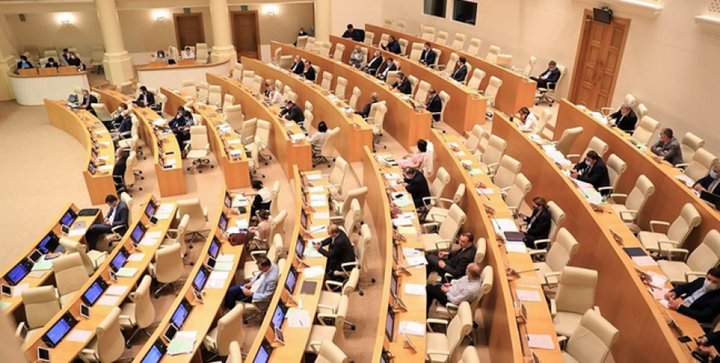
The Public Defender of Georgia submitted an alternative report to the Parliament of Georgia relating to the 2023 report of the Ministry of Justice of Georgia on the execution of judgments delivered by the European Court of Human Rights against Georgia (pending cases).
The alternative report reviews the general measures taken by the State as of 2023 to execute the judgments delivered by the European Court against Georgia in the following cases: “Tsintsabadze Group”, “Identity Group”, “Merabishvili v. Georgia” and “Tkhelidze Group”. The document analyzes whether the steps taken by the State are sufficient for the execution of the above-mentioned cases.
The report addresses issues such as fight against hate crimes and ill-treatment, freedom of assembly of the LGBT+ community, gaps in the administration of justice relating to the cases of violence against women and domestic violence judgments and femicide, etc.
The alternative report also offers recommendations on additional general measures needed to execute the above-mentioned of the European Court of Human Rights.