Category Archives: Related Links
THAILAND OMBUDSMAN, MR. SONGSAK SAICHEUA INITIATES A SYSTEMIC INVESTIGATION ON TOUGHER LAW FOR ROAD SAFETY


As many as 939,713 road accidents were reported in 2022, up 4.7% from 2021, the
Thailand Road Accidents Data Centre for Road Safety Culture (ThaiRSC) said. According to
data revealed by ThaiRSC, road accidents claimed 14,737 lives and injured 924,799 in
Thailand. Of them, 536 deaths and 7,885 injuries were foreigners. Statistics show that more
than half of the accidents (55.9%) involved motorbikes. Among the 14,737 lives lost, 360
deaths at the crossroad were officially reported. Thai RSC said that the average damage
incurred per accident was about 200,000 baht, while other mental, social and economic
impacts for families are immeasurable.
Considering this frightening statistic as crucial incident harming well-being of Thai
people and society, Mr. Songsak Saicheua Thai Ombudsman launch a systemic investigation
seeking solutions to amend obsoleted and ineffective laws and regulations. Ombudsman’s
resolution aims to reduce death rate caused by road accidents, especially the crossroad.
Currently, traffic violators are fine for 4,000 baht if they are caught not stopping at the
crossroad. Ombudsman also encourages concerned agencies such as Department of Land
Transportation (DLT), Royal Police Bureau, Department of Highways, Public Transportation
Service Network such as Taxi drivers’ group, Motorcycle riders’ group, Food and Parcel
delivery Companies, Bangkok Mass Transit Authority (BMTA) The Transport Co., Ltd, as well as
private networking group.
A good consultation with DLT and Royal Police Bureau leads Thailand Ombudsman to
propose recommendations on tougher law enforcement in order to yield a more safety zone,
especially crossroad area, for pedestrians and drivers. Ombudsman’s recommendations such as more restriction on speed limit, more fines for law breakers, and all vehicles MUST stop at the crossroad when there is pedestrian crossing (current law only SUGGEST EVERYONE TO AWARE) etc. Recommendations will be submitted to the Cabinet for consideration.
From the Ombudsman Songsak’s initiatives, DLT and Royal Police Bureau took it on
board and amended few regulations and enforcement. The two offices agree to merge
license and permission database so that the traffic law violation could be verified by
authorities, moreover, agree to set up the score deduction criteria for driving permission.
Funds from Road Safe Fund were allocated to promote road safety projects. Several road
safety campaigns and public relation programs were introduced through social media and
public television programs to show their strong commitment. With cooperation from Ministry
of Education and DLT, road safety curriculum for primary education will be developed to be
part of the day-to-day learning and practice. DLT launches campaign called “Beware of
pedestrians, when you drive. Beware of vehicles, when you cross the street.” in order to
raise public awareness. The office of the Ombudsman has also stepped up the coordination
and integration among the agencies and parties concerned in the public and private sectors
as well as the civil society in the law enforcement and carrying out the public awareness
raising campaign.
ACRC CONDUCTED CORRUPTION RISK ASSESSMENT OF BYLAWS OF 506 PUBLIC INSTITUTIONS, REMOVING 4,722 CORRUPTION-CAUSING FACTORS INHERENT THEREIN
Customarily practiced acts of corruption in public institutions, including overseas business trip, abuse of authority over personnel affairs and unfair contract, etc., blocked at the source. The results of Corruption Risk Assessment (CRA) on bylaws of public institutions in the country conducted during a span of last three years have found that corruption-causing factors such as overseas business trips, abuse of authority over personnel affairs and unfair contract, etc. have been removed, raising an awareness of integrity of executives and staff members of public institutions.
Anti-Corruption and Civil Rights Commission (ACRC, Chairperson Jeon Hyun-Heui) carried out CRA on bylaws of 506 public institutions for the last three years from 2020 to 2022 and published the results.
ACRC established a legal foundation for the CRA* of public institutions closely related to the public life by amending the Act on the Prevention of Corruption and Establishment and Operation of the Anti-Corruption and Civil Rights Commission in 2009 and started to conduct the CRA on public corporations first, and in order of local firms, industrial complex, quasi-government organizations, and other types of public institutions.
* Corruption Risk Assessment: a primary corruption prevention system aimed at preemptively eliminating corruption risks in the course of implementation of laws and regulations by analyzing, identifying, removing, and improving corruption-causing factors inherent in those laws and regulations from the very stage of drafting thereof
As a result of the CRA, ACRC identified 4,722 factors with potential for corruption inherent in 48,174 bylaws of 506 public institutions in the country and offered them recommendations for improvement.
ACRC has also established measures to prevent fake and overseas business trip by executives and staff members of public institutions. Specifically, the measures include mandatory submission, etc. of evidence s to prove trips are for business purposes and reinforcement of preliminary examinations of overseas business trips.
In addition, ACRC has also blocked the possibility for unqualified officials to get promoted by extending the period of limitations on promotion in the case of an official who committed acts of serious irregularities and has clarified the standard for special employment which had been vague previously. Furthermore, the Commission has removed factors that may cause hiring irregularities by making it mandatory for public institutions to go through a personnel committee for any special employment.
To secure fairness in contract, ACRC prohibited entering into a private contract for two years with retired public officials or companies by which retirees are employed as executives.
ACRC also prepared measures to prevent research-related irregularities, including specifying the scope of private interests of investigation commissioners of research ethics violations, disclosing the list of investigation commissioners and the result of investigation, reinforcing sanctions on those committing research-related irregularities, prohibiting indiscreet provision and illegal use of gift certificates, controlling the use of corporate cards, and strengthening conflict-of-interest preventive rules related to the establishment and management of major review board.
It was found as a result of the CRA that statistically, an average of 9.3 corruption-causing factors per public institution have been removed.
By type of public institution, public institutions whose type is categorized as others have received the greatest number of recommendations for improvement (2,250), followed by local firms/industrial complex (1,756), quasi-government organizations (501) and public corporations (215), indicating that institutions given relatively higher levels of leeway in the management and lower control from the government has received more recommendations for improvement from the ACRC.
By content of recommendations, those related to eradication of personnel or hiring irregularities took up the biggest proportion, amounting to 2,233 cases (47.3%), followed by those concerning improvement in unfair work practices (1,309 cases, 27.7%) and transparency enhancement in the course of institutional management (1,181 cases, 25.0%).
By specific area of duties, among 11 areas, the highest number of recommendations have been offered to the four areas, such as personnel, contract, committee, and service, accounting for 79.4% (3,750 cases), implying many corruption-causing factors existed in the area of duties related to personnel and contract affairs, including the abuse of authority over HR management and unfair contract by the head of a public institution.
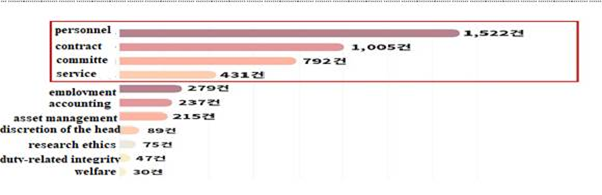
After completing the CRA, ACRC surveyed members of the 506 public institutions (278 people responded) and found that the level of integrity awareness has been also improved.
Respondents who said “as a result of the CRA, the level of integrity of executives and employees was raised” stood at 66.9%, more than twice as many as those with negative perceptions (33.1%). Also, respondents who thought the CRA was helpful in preventing corruption in their institutions accounted for 80.2%.
In particular, the CRA has had a diagnostic effect regarding corruption in general management of public institutions, as the level of integrity in all areas of duties, including HR, employment, contract, accounting, and conflict-of-interest, has been evenly improved.
According to the result of the 2022 corruption perception survey of public servants, it was found the level of integrity of public institutions has been enhanced both internally and externally, with more public officials having perceptions of their institutions’ integrity level as improved, scoring 60.9 points on average, one and a half times more than the number of respondents with negative perceptions (39.1 points).
Furthermore, 69.1% of the institutions which experienced the CRA felt the need for it and the number of those interested in voluntary implementation of autonomous CRA and development of assessment capabilities increased as well.
The Vice Chairperson of the ACRC, Ahn Sung-Wook, said, “As the CRA conducted over the span of last three years on public institutions have improved the level of integrity and perceptions of autonomous corruption risk assessment in public institutions, the ACRC will continue to support institutions in their voluntary prevention of corruption in various manners and make efforts to prevent corruption in the public sector through CRA.”
OFFICE OF THE OMBUDSMAN ANNOUNCES RESULTS OF DIRECT INVESTIGATION INTO GOVERNMENT’S ENFORCEMENT AGAINST UNAUTHORISED BUILDING WORKS IN NEW TERRITORIES EXEMPTED HOUSES

The Ombudsman, Ms Winnie Chiu, announced at a press conference the completion of the direct investigation into the Government’s enforcement against unauthorised building works (UBWs) in New Territories Exempted Houses (NTEHs) and made 11 recommendations for improvement to the Buildings Department (BD) and the Lands Department (LandsD).
In April 2012, the Government implemented an enhanced enforcement strategy against UBWs in NTEHs. The BD, as the enforcement authority, takes priority actions against UBWs constituting imminent danger, UBWs under construction or newly completed ones (Note), and existing UBWs not posing imminent danger but constituting serious contravention of the law and posing higher potential risks that are first-round targets, while the LandsD plays a supporting role in BD’s enforcement by providing relevant information.
Investigation by the Office of The Ombudsman reveals that the number of reports of UBWs received by the BD had risen from 2,127 in 2012 (since April) to 8,552 in 2021. As at the end of 2021, nearly half of the removal orders issued by the BD were against UBWs built after the implementation of the enhanced strategy (i.e. UBWs under construction or newly completed). Around one quarter of the removal orders issued against UBWs under construction were outstanding while the deadline for removal had passed, among which about 68% were issued in or before 2018. Removal orders regarding newly completed UBWs revealed a similar problem. This shows that BD’s enforcement actions have been ineffective in curbing the proliferation of UBWs. In some of the cases studied, the BD took 9 to 18 months after site inspection to issue a removal order against UBWs under construction, which is an obvious failure to meet the objective of taking “immediate” enforcement action.
Moreover, the progress of large-scale operations for the identification of first-round targets has been slow. In the past decade, the BD completed inspections of only about 46% of recognised villages in the territory. On the whole, as at the end of 2021, 2,016 (about 37.4%) of the 5,384 removal orders issued by the BD were outstanding while the deadline for removal had passed. The Office randomly checked some long-standing non-compliant cases and found that BD’s issuance of removal orders was followed by years of inaction.
The Office’s investigation also reveals that among the 972 convictions for non-compliance with removal orders in the past decade, the average fine was about $9,500 only and there were only nine cases (involving three NTEHs) in which imprisonment was imposed. The average fine upon re-conviction for persistent non-compliance increased to about $13,400 only. The Office finds the existing penalty insufficient to deter non-compliance. On the other hand, as the BD has not made use of the information collected from its enforcement actions to compile statistics on UBWs, it is difficult for the Department to make systematic assessment of the effectiveness of the enhanced strategy and the changes after its implementation. There is also room for improvement in the mechanism for information exchange and co-ordination between the BD and the LandsD.
Ms Chiu said, “It is commendable of the Government to have implemented the enhanced strategy with a clear policy objective to step up enforcement against UBWs in NTEHs. Nevertheless, our findings reveal multiple inadequacies in the actual implementation of the strategy in the past decade that inhibit full accomplishment of the policy objective. While we acknowledge the continuous effort of the BD in curbing UBWs, the slow progress of large-scale operations and the backlog of cases reflect that the Department may not have the capacity to manage all necessary enforcement actions. The BD should consolidate its experience in implementing the enhanced strategy in the past decade, holistically review the policy and resource utilisation and explore how the limited resources can be utilised pragmatically to target the most serious types of UBWs and repeated offenders for the time being. The Department should in tandem formulate performance indicators for measuring effectiveness in accordance with the policy objective.”
The Office’s major recommendations made to the BD include:
- review the existing guidelines and set clearer internal targets for processing tasks other than site inspections regarding UBWs under construction;
- explore streamlining the enforcement procedures for tackling UBWs under construction;
- review the existing arrangements for consultants’ submission of work reports regarding large-scale operations and proactively identify areas for streamlining (such as more extensive use of electronic submission of reports), as well as explore measures to expedite the vetting of consultants’ reports;
- step up the monitoring of follow-up and enforcement actions on UBWs in NTEHs and the clearance of backlog cases of non-compliance in accordance with the internal timetable;
- reflect to the Court the seriousness of cases involving flagrant contravention of the law or continuing irregularities and step up prosecutions against persistent non-compliant owners for greater deterrent effect;
- compile statistics on UBWs based on the information collected from follow-up and enforcement actions for analysis purposes; and
- holistically review the policy of the enhanced strategy and resource utilisation, explore how the limited resources can be utilised pragmatically to target the most serious types of UBWs and repeated offenders for the time being, and in tandem formulate performance indicators for measuring effectiveness in accordance with the policy objective.
The Office also recommends that the BD and the LandsD regularly monitor pending cases with information outstanding to ensure there is no delay or omission in information exchange. The two departments should also consider setting up an interdepartmental liaison group to strengthen co-ordination and enhance the effectiveness of handling special cases.
The BD and the LandsD have generally accepted the Office’s recommendations.
OMBUDSMAN INSTITUTION PLAYED ITS SUCCESSFUL ROLE IN THE JOURNEY OF FOUR DECADES IN PROVIDING SPEEDY & INEXPENSIVE RELIEF TO A COMMON MAN.
- ROLE OF MEDIA IN SENSITIZING THE FUNCTIONING OF OMBUDSMAN INSTITUTION AMONG THE GENERAL PUBLIC IS REMARKABLE.
- FEDERAL OMBUDSMAN INSTITUTION IS RENDERING SERVICES FOR POOR AND BACKWARD CLASSES.
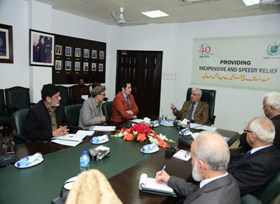
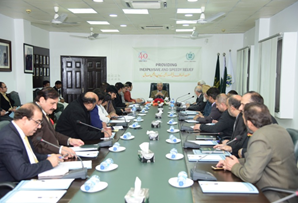
The Federal Ombudsman appreciated the role of media in sensitizing the functioning of Ombudsman institution among the general public. This was stated by Federal Ombudsman Ejaz Ahmad Qureshi while briefing the Islamabad Crime and Court Reporters Association (ICCRA) in his office today. He said that maladministration and bad governance are two sides of the same coin. Both breed in an environment of favoritism, discrimination and corruption. Addressing maladministration, therefore, is essential for ensuring sanctity of human rights and achieving the ultimate goals of good governance and the rule of law. He said that in the absence of Child Ombudsman, the Ombudsman institution has developed a road map for strengthening laws and mechanism for protection of child rights and effective measures to control cyber crimes against children. The Ombudsman institution has played its successful role in the journey of four decades in providing speedy and inexpensive relief to a common man, he added.
While highlighting the achievements of Ombudsman’s Office, he said that it was worth mentioning that year 2022 witnessed the highest ever number in complaints registration i.e. 164,174 complaints with 49% increase as compared to 2021, and the disposal also reached to all time high of 157,770 marking an increase of 47.7% over the figures of 2021. The Ombudsman said that people’s trust has immensely increased resulting in a major increase in the registration of complaints. He added that complaints worth over Rs. 3 Billion amount were resolved, as against the value of Rs. 2.34 Billion of last year. This has greatly contributed in lessoning the load on judicial courts in the country. Reviewing the performance of the Wafaqi Mohtasib’s institution during the last forty years, Mr. Qureshi stated that more than 1.9 million households have benefitted from the services of this Office since its inception.
He further said that Outreach Complaint Resolution (OCR) Project is successfully functioning in the far flung areas. It has now been further strengthened by holding Khuli Katchehries(Open Hearing). These steps are contributing immensely in providing administrative justice to complainants against the Federal agencies, closer to their homes. He said that the presence of Ombudsman Office has been expanded to erstwhile FATA areas and recently two sub offices have been established at Wanna (South Waziristan) and Sada (Kurram District), with the sole idea of enhancing its outreach to remote areas.
Mr. Ejaz Qureshi said that the Ombudsman’s Office has diversified its activities by under taking inspections of various agencies against whom persistent complaints were pouring in. Teams constituted by Ombudsman carried out inspections of agencies such as Passport Office, National Savings (CDNS) , Airport , Nadra ,Polyclinic, PIMS, Utility Stores, CDA and alike with a view to improving their service delivery.
Under the Informal Resolution of Disputes, 1114 cases were disposed of since its introduction in April, 2022 and 266 cases are in process, he added. He reiterated that a large number of Overseas Pakistanis are being facilitated at all International Airports in Pakistan under One Window Facilitation Desks, and their complaints are resolved on the spot.
THE REGIONAL REPRESENTATIVES OF THE OMBUDSMAN MADE MONITORING VISITS TO STUDY THE CONDITIONS OF DETENTION OF PERSONS HELD IN CLOSED INSTITUTIONS WITH LIMITED FREEDOM OF MOVEMENT
It is no secret that the sharp deterioration of the weather in the country has caused a number of difficulties in the life of society. These days, the Regional representatives of the Ombudsman made monitoring visits to study the conditions of detention of persons held in closed institutions with limited freedom of movement.
In particular, on January 12 and 14, 2023, the Regional Representative of the Authorized Person of the Oliy Majlis for Human Rights (Ombudsman) in the Khorezm region, Odilbek Ollayorov, made monitoring visits to the Khorezm regional branch of the Republican Specialized Scientific Narcological Center and Practical Medicine and Detention Center No. 11.
When checking the heat, electricity and gas supply of the regional branch of the Narcology Center in the Khorezm region, it was found that the building of the institution is heated using two coal-fired heating boilers and provided with a sufficient amount of coal reserves.
It has been established that the temperature in the rooms where patients are treated, in office premises and in common areas is below the established norm.
It was also established that there were interruptions in the supply of electricity according to the schedule, measures were taken for autonomous supply of electricity in such cases, the branch was equipped with water heating equipment for supplying hot water.
The management of the institution was recommended to replace the coal-fired boilers used for heating the branch building with modern economical boilers.

WORKING MEETING ON CHILDREN LIVING AND WORKING ON STREETS
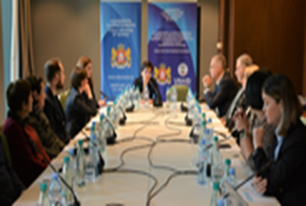
On January 25, 2023, the Public Defender’s Office of Georgia held a working meeting with representatives of state agencies and service providers on the rights of children living and working on the street.
The working meeting was held in a discussion format. The Chairman of the Human Rights and Civil Integration Committee of the Parliament of Georgia, the Chairman of the Permanent Parliamentary Council for the Rights of the Child, representatives of the Governmental Administration, various ministries, state agencies and service providers took part in the meeting.
Acting Public Defender Tamar Gvaramadze spoke about the scarcity of support services for children living and working on the street and their families, as well as gaps in terms of protection of children against violence, exploitation, discrimination, trafficking and other crimes.
In addition, Tamar Gvaramadze welcomed the recent positive aspects, such as: the development of the 2023-2026 strategy for the protection of children living and working on the street; the opening of a day center for children in Batumi; implementation of a 24-hour emergency response mechanism in the State Care Agency. She expressed hope that the meeting would help relevant services to effectively protect the rights of children living and working on the street and to solve their problems.
The meeting participants also talked about the rights situation of children living and working on the street and outlined the activities carried out in this direction, existing challenges, including the problems identified in the provision of services. At the same time, attention was focused on the need to ensure children’s safety, provide a child-oriented and systemic approach, strengthen coordination and introduce additional services.
The working meeting was held with the support of the USAID-PDO partnership programme of the grant agreement between the Public Defender’s Office and the United States Agency for International Development (USAID).